
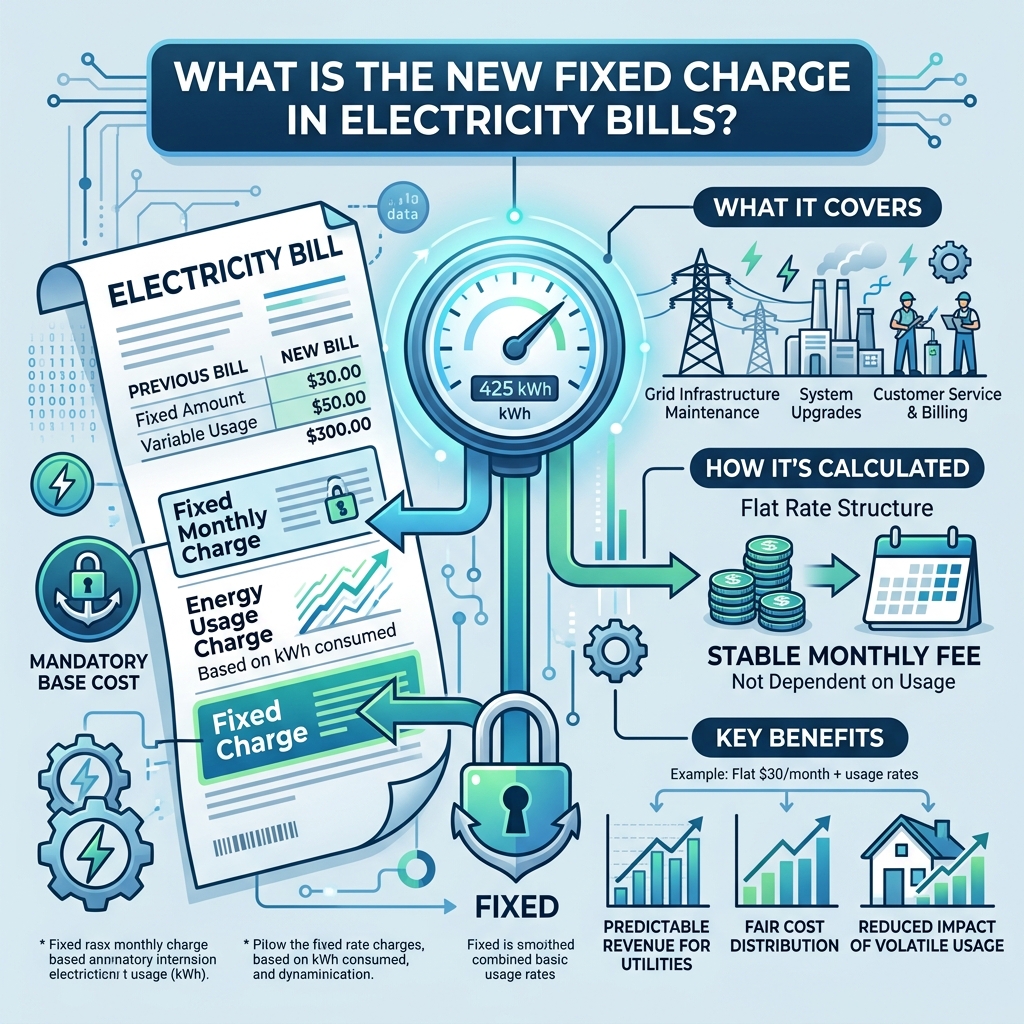
What Is the New Fixed Charge in Electricity Bills? – Simple, Complete Explanation
The “new fixed charge” on your electricity bill is a monthly fee based on your sanctioned load (in kW), not on how many units you consume.
In simple words:
Even if you use very few units (or zero units) in a month, you still have to pay this fixed charge just for having an electricity connection.
This was introduced/approved by NEPRA in February 2026 and is now being applied across most DISCOs (LESCO, FESCO, MEPCO, GEPCO, PESCO, HESCO, QESCO, TESCO, HAZECO, SEPCO, IESCO — or K-Electric, etc.).
Starting with NEPRA's determination on February 11, 2026, a new charge appears on Pakistani electricity bills that has nothing to do with how many units you consumed. It's a fixed monthly charge based on your sanctioned load—the maximum electricity capacity, in kilowatts (kW), that your connection is officially approved for. Whether you used 50 units or 500 units that month, this charge is the same, because it's billing you for the size of your connection, not your consumption.
Why Was This New Fixed Charge Introduced?
Before 2026, many low‑usage domestic consumers paid very low or almost zero fixed charges. The government and NEPRA changed this to:
- Recover fixed costs of the power system (wires, poles, transformers, staff, metering, etc.).
- Reduce cross‑subsidies (where some consumers indirectly pay others’ costs).
- Meet IMF and reform conditions for more cost‑reflective tariffs.
So now, everyone (except some lifeline consumers) pays a per‑kW monthly fixed charge, regardless of consumption.
How Is the New Fixed Charge Calculated?
The new fixed charge is
Fixed Charge (Rs) = Fixed Charge Rate (Rs/kW/month) × Your Sanctioned Load (kW)
Key points:
It depends on:
- Your sanctioned load (written on your bill, e.g., 3 kW, 5 kW, 7 kW).
- Your consumption slab (1–100 units, 101–200 units, etc.).
- Whether you are a protected or unprotected consumer.
It does not depend on how many units you actually used that month.
Worked examples:
| Sanctioned Load | Approx. Rate | Monthly Fixed Charge |
|---|---|---|
| 2 kW | Rs. 200/kW | Rs. 400 |
| 2 kW (Unprotected, higher slab) | Rs. 550/kW | Rs. 1,100 |
| 5 kW | Rs. 500/kW | Rs. 2,500 |
| 6 kW | Rs. 675/kW | Rs. 4,050 |
Where to find your sanctioned load: it's listed in the consumer details block at the top of your bill, in kilowatts—the same section that shows your reference number and tariff type.
Why NEPRA Introduced This
According to the Power Division's petition and NEPRA's public hearings, the reasoning behind shifting some cost recovery to a fixed charge includes:
- Capacity payments to Independent Power Producers (IPPs). Pakistan's power sector has long-term agreements with IPPs that guarantee them payment for available generation capacity, whether or not that electricity is actually used. These "take-or-pay" obligations run into hundreds of billions of rupees annually and have to be recovered from someone—historically, entirely through per-unit charges.
- Grid infrastructure costs don't scale down with usage. Transmission lines, transformers, and substations cost roughly the same to maintain regardless of how much electricity flows through them in a given month.
- Reducing the incentive to under-report or disconnect from the grid. A purely volumetric system meant that consumers who reduced their metered usage—through theft or by switching heavily to solar—contributed less toward fixed system costs even while still relying on the grid as backup. A capacity-based charge is designed to close that gap.
- Revenue targets. Officials have stated the fixed-charge framework is projected to generate approximately Rs. 132 billion annually, alongside reallocating an estimated Rs. 101 billion in subsidy support from residential consumers toward industrial consumers.
As part of the same package, NEPRA also reduced the average base per-unit energy tariff slightly — from roughly Rs. 32.73/unit to Rs. 31.59/unit — so the change is better understood as a rebalancing between variable and fixed cost recovery, not simply an addition on top of unchanged unit rates.
New Fixed Charge Rates (2026, Domestic Consumers)
Below are the typical 2026 fixed charge rates approved by NEPRA for domestic consumers (other than lifeline). Exact numbers can vary slightly by DISCO and notification, but the structure is like this:
Protected Consumers (A‑1P, ≤ 200 units average)
| Monthly Consumption | Fixed Charge Rate |
|---|---|
| 1–100 units | Rs 200 per kW per month |
| 101–200 units | Rs 300 per kW per month |
Lifeline consumers (very low usage, e.g., 0–50 units, depending on DISCO rules) are often exempt or pay minimal fixed charges.
Unprotected Consumers (A‑1, normal domestic)
| Monthly Consumption | Fixed Charge Rate |
|---|---|
| 1–100 units | Rs 275 per kW per month |
| 101–200 units | Rs 300–400 per kW per month (varies by DISCO) |
| 201–300 units | Rs 350 per kW per month |
| 301–400 units | Rs 400 per kW per month |
| 401–500 units | Rs 500 per kW per month |
| 501–600 units | Rs 600–675 per kW per month |
| 600+ units | Up to Rs 675 per kW per month |
Many DISCOs now cap the highest slab at Rs 675/kW/month for very high consumption.
Note: Some older bills showed fixed charges as a flat Rs/month (e.g., Rs 200, Rs 400). The new system is per kW, so two houses with the same units but different sanctioned loads will pay different fixed charges.
Example: How Much Will You Pay?
Assume:
- Your sanctioned load = 5 kW
- You are an unprotected consumer
- Your monthly consumption = 250 units (falls in the 201–300 slab)
- Fixed charge rate for 201–300 units = Rs 350/kW/month
Then:
Fixed Charge = 5 kW × 350 = Rs 1,750 per month
This Rs 1,750 is added to your bill even if:
- You used 250 units that month, or
- Hypothetically, you used only 50 units but still have a 5 kW connection (you’d be in a different slab, but still pay per kW).
Protected Consumer Example
Same 5 kW load, but:
- You are protected
- Consumption = 150 units (101–200 slab)
- Fixed charge rate = Rs 300/kW/month
Then:
Fixed Charge = 5 × 300 = Rs 1,500 per month
Where Does This Fixed Charge Appear on Your Bill?
On your electricity bill, look for lines like
- Fixed Charges
- FC
- Fixed Monthly Charge
- Rs/kW/M or Rs/Cons/M
It will usually show:
- Rate (e.g., Rs 350/kW/M)
- Sanctioned load (e.g., 5 kW)
- Total fixed charge amount (e.g., Rs 1,750)
This amount is added before taxes (GST, TV fee, etc.), so it also increases your taxable base.
How Is This Different From the Old Fixed Charge?
Old system (before 2026):
- Fixed charges were often low flat amounts (e.g., Rs 150–400 per month) for many domestic consumers.
- Some low‑usage consumers effectively paid almost nothing as a fixed charge.
New system (2026 onward):
- Fixed charge is per kW of sanctioned load.
- Rates are higher and vary by consumption slab and consumer type (protected vs. unprotected).
- Applies to almost all domestic consumers except some lifeline.
- Even if you consume very few units, you still pay a significant fixed amount.
Result:
For many middle‑class households, the minimum bill has gone up noticeably, even if their units haven’t changed.
Who Is Most Affected?
The new fixed charge hits hardest:
- Households with higher sanctioned load (e.g., 5 kW, 7 kW, 10 kW).
- Consumers who use fewer units but still have a large connection (e.g., people who travel often or have solar but still rely on the grid).
- Unprotected consumers in higher slabs (300+ units), where fixed charges go up to Rs 600–675/kW/month.
It affects lifeline and very low‑usage protected consumers less, as they are either exempt or pay lower rates.
Can You Reduce This Fixed Charge?
You cannot remove it, but you can potentially lower it:
Check your sanctioned load on the bill.
- If your actual load is much lower than sanctioned (e.g., you only use lights, fans, and the fridge but are sanctioned for 7 kW), you can apply to your DISCO for load reduction.
- Lower sanctioned load → lower fixed charge.
Stay in lower consumption slabs.
- While the fixed charge is per kW, some slabs have lower rates.
- Reducing units can move you to a slab with a lower Rs/kW/month rate.
Use solar/net metering wisely.
- Even with solar, you still pay a fixed charge on your grid connection, but you can reduce your energy charges and FPA.
- Fixed charge remains as long as you keep the connection.
Yes, it applies even if you have solar panels.
This is the detail that's generated the most frustration among consumers who invested in solar specifically to cut their electricity costs: the fixed charge is based on your sanctioned grid connection, not your net grid consumption. A household with solar panels that draws very little from the grid in a sunny month still pays the fixed charge in full, because the charge reflects the capacity they remain connected to and could draw on—not what they actually used.
The Charge Is Currently Being Legally Challenged
It's worth knowing this isn't a settled, uncontroversial matter. In March 2026, a review petition was filed with NEPRA challenging the February 11 determination—jointly submitted by several prominent petitioners, including a former federal interior minister. Their central argument is that a charge applied "irrespective of actual electricity consumption" unfairly burdens consumers, particularly those with larger sanctioned loads but genuinely modest usage.
It's also worth noting that when the framework was originally presented at NEPRA's public hearings, no representative appeared on behalf of the roughly 28.5 million residential consumers who would be directly affected — meaning the consumer side of the debate has, so far, been raised mainly after the fact, through petitions like this one, rather than during the original hearing process.
As of this writing, the fixed charge remains in effect on bills while the review petition is pending. Given that a formal legal and regulatory challenge is active, it's reasonable to expect this could see further adjustment—check NEPRA's official determinations for the latest status before assuming the current rates are permanent.
Quick Summary
- New fixed charge = monthly fee based on sanctioned load (kW), not units.
- Approved by NEPRA in February 2026, applied across most DISCOs.
- Rates range roughly from Rs 200/kW/month (low‑usage protected) to Rs 675/kW/month (high‑usage unprotected).
- You pay it even if you use very few or zero units.
- Appears on your bill as Fixed Charges / FC / Rs/kW/M.
- Reducing your sanctioned load and optimizing usage can help lower the impact, but you cannot avoid it entirely if you keep a grid connection.
Related Reading
- Protected vs. Unprotected Consumers—the classification that determines both your energy rate and your fixed-charge tier.
- Fuel Price Adjustment (FPA) Explained—the separate monthly charge tied to fuel costs, not connection capacity.
- Slab Benefit & Slab Jump Explained—how the energy-charge slab structure works underneath all of this.