
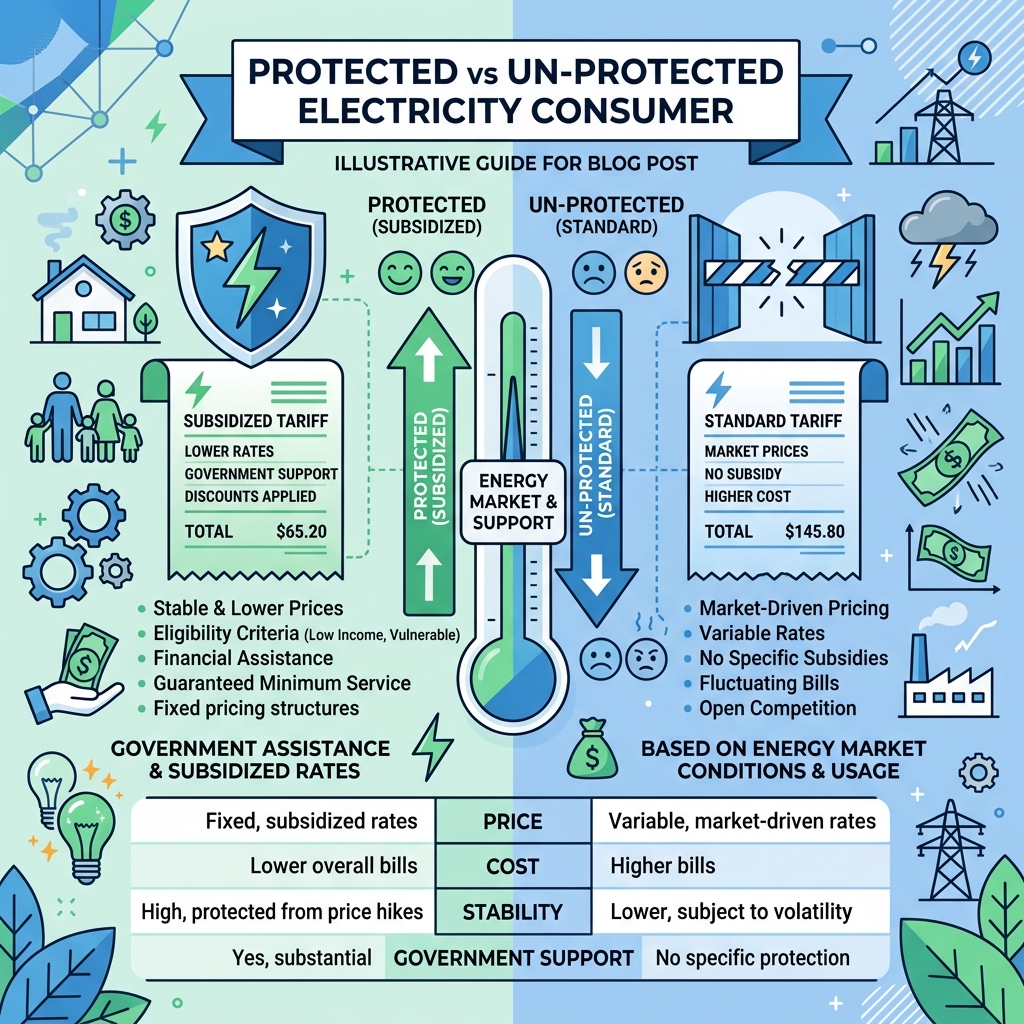
The Single Biggest Variable on Your Bill
A Pakistani electricity bill is never just a unit's × rate. NEPRA sets slab tariffs that step up sharply after certain thresholds; CPPA-G recovers monthly fuel costs through the Fuel Price Adjustment (FPA); and both federal and provincial governments add taxes and surcharges on top. Of all these moving parts, whether your connection is classified Protected or Unprotected is the single biggest factor — bigger than a month's FPA change, bigger than normal seasonal usage swings. This guide breaks that classification down completely, with the actual NEPRA rate table so that you can read your own bill line by line.
What Makes You a Protected Consumer
A Protected Consumer is a low‑usage residential household that gets a heavily subsidised electricity tariff from the government/NEPRA. your connection must meet all three conditions at once:
- Monthly consumption of 200 units or fewer.
- No air conditioner registered on the meter — this is about what's on your DISCO's official record, not whether you actually use an AC.
- Sanctioned load under 5kW.
Who Qualifies as a Protected Consumer? (2026 Rules)
To be a Protected Consumer, you must meet all of these conditions:
A. Average Monthly Consumption ≤ 200 Units
- Your average monthly consumption over the last 6 billing months must be 200 units or less.
- It’s not about one month; it’s about the 6‑month average.
Examples:
- If your last 6 months’ usage is: 180, 190, 200, 170, 195, 185 → average ≈ 187 → Protected.
- If your last 6 months’ usage is: 220, 210, 190, 230, 205, 215 → average ≈ 212 → Unprotected.
Protected consumers pay a subsidized per-unit rate and, unlike Lifeline consumers, also receive the benefit of the previous slab rate applied to part of their consumption (explained further below).
What Makes You an Unprotected Consumer
You fall under A-1 Unprotected if any one of the following is true:
- Your consumption crosses 200 units in a given month, or
- An air conditioner is registered on your meter's sanctioned load, or
- Your sanctioned load exceeds 5kW.
Unprotected billing follows a steep progressive slab structure, and — this is the detail that catches most people off guard — the higher rate applies to your entire month's consumption, not just the units above 200.
What Happens When You Become Unprotected?
Once your 6‑month average crosses 200 units, your status changes from Protected → Unprotected. This causes:
A. Much Higher Per‑Unit Rates
Your per‑unit tariff jumps significantly, especially in the first 200 units.
Approximate 2026 rates (before FPA, taxes, etc.):
For 1–100 units:
- Protected: ~Rs 10.5–11.7 per unit
- Unprotected: ~Rs 16.5–22.4 per unit
For 101–200 units:
- Protected: ~Rs 13.0–14.2 per unit
- Unprotected: ~Rs 22.9–23.0 per unit
Above 200 units, everyone pays unprotected rates, so the difference is only in the first 200 units.
Result:
A house using 180 units as “protected” might pay around Rs 2,500–3,000 (before taxes/FPA).
The same 180 units as “unprotected” can easily cross Rs 4,500–5,500 (before taxes/FPA), almost double.
B. Higher Fixed Charges (From 2026)
From 2026, fixed monthly charges are also being applied/adjusted based on your sanctioned load and consumption, even for some protected consumers.
Approximate fixed charges (per kW per month, as per recent NEPRA proposals/approvals):
- Protected (1–100 units): ~Rs 200 per kW/month
- Protected (101–200 units): ~Rs 300 per kW/month
- Unprotected (1–100 units): ~Rs 275 per kW/month
- Unprotected (101–200 units): ~Rs 300 per kW/month
- Higher slabs (300, 400, 500, 600+ units): fixed charges go up to ~Rs 675 per kW/month.
The Official NEPRA Rate Table (A-1 Residential Tariff)
This is the current notified rate structure under S.R.O. 938(I)/2023, showing the base variable charge per unit (Rs./kWh) before FPA, GST, and other surcharges are added:
Protected — Sanctioned load up to 5kW
| Slab | Rate (Rs./kWh) |
|---|---|
| Up to 50 units (Lifeline) | 3.95 |
| 1–100 units (Lifeline) | 7.74 |
| 1–100 units (standard Protected) | 7.74 |
| 101–200 units | 10.06 |
Unprotected — Sanctioned load up to 5kW
| Slab | Rate (Rs./kWh) |
|---|---|
| 1–100 units | 16.48 |
| 101–200 units | 22.95 |
| 201–300 units | 27.14 |
| 301–400 units | 32.03 |
| 401–500 units | 35.24 |
| 501–600 units | 36.66 |
| 601–700 units | 37.80 |
| Above 700 units | 42.72 |
Sanctioned load 5kW and above — Time of Use (TOU)
| Period | Rate (Rs./kWh) |
|---|---|
| Peak hours | 41.89 |
| Off-peak hours | 35.57 |
Note: NEPRA revises base tariffs periodically through new SROs, and every bill also carries a monthly Fuel Price Adjustment (FPA), GST, and other surcharges on top of these variable charges. Treat this table as the reference structure, and always confirm the exact figures currently printed on your DISCO's official tariff card or your duplicate bill for the most current numbers.
The Slab Benefit — Why Protected Consumers Get an Extra Discount
Under NEPRA's rules, only Protected residential consumers receive what's called the "previous slab benefit" — meaning part of their consumption is calculated using the lower rate from the slab below, rather than the entire amount jumping straight to the new slab's rate the moment they cross a threshold. Lifeline consumers do not receive this benefit. This is one reason two households using a similar number of units can still see noticeably different bills depending on their exact classification.
How Your Status Actually Gets Set
There are two layers to how this works, and it's worth understanding both:
- The original policy basis: Under the Ministry of Energy's June 2021 policy guidelines (implementing SRO Nos. 374–383(I)/2018 and later amendments), the Protected category was formally defined as consumers who consistently use 200 units or fewer per month over the preceding six months.
- In practice, month to month: Most DISCOs re-evaluate your tariff classification fresh each billing cycle based on that month's actual consumption. If you normally use 180 units but one hot month pushes you to 220, that specific month's entire bill is calculated at Unprotected rates — not just the extra 20 units. The following month, if you drop back under 200 units (and still have no AC registered and sanctioned load under 5kW), you're reclassified as Protected again.
The practical takeaway: households that hover consistently around 180–210 units are the most exposed to sudden, disproportionate bill spikes from a single high-usage month — because the jump isn't proportional to the units over the line, it applies to the whole bill.
The Air Conditioner Rule — The Rule That Surprises People Most
This is worth its own section because it trips up more people than the 200-unit threshold itself.
If an air conditioner is formally registered under your meter's sanctioned load, your connection is billed as Unprotected — every month, regardless of actual usage. It doesn't matter if the AC sits unused for eight months of the year, or if you've physically disconnected or even removed it. What determines your status is whether the AC is still listed on your DISCO's official sanctioned-load record.
To remove it from your record, you need to submit a formal load revision application with your DISCO — simply unplugging or uninstalling the unit doesn't change your billing classification. This typically requires an inspection visit, and sub-divisional offices can be slow to process these requests, so it's worth following up in person and keeping a record of each visit.
The 5kW Sanctioned Load Rule
If your sanctioned load exceeds 5kW, you're typically on a three-phase connection, and you move to Time of Use (TOU) billing instead of the standard residential slab structure — meaning you're billed differently depending on whether your usage falls in peak or off-peak hours, rather than by a simple monthly unit total.
For most single-phase residential households, sanctioned load stays comfortably under 5kW, so this condition rarely comes into play on its own. It becomes relevant mainly for larger properties running multiple high-draw appliances, or where industrial-type equipment shares a meter with residential use.
Where to Check Your Own Status on the Bill
Look for the Tariff Type field in the consumer details section at the top of your bill — the same section listing your name, reference number, and meter details:
- A-1(P) or A-1P = Residential Protected
- A-1 (no "P" suffix) = Residential Unprotected
This same A-1 / A-1P notation is used consistently across all DISCOs — LESCO, FESCO, MEPCO, GEPCO, PESCO, HESCO, QESCO, TESCO, HAZECO, SEPCO and IESCO. You can check this field on your official duplicate bill through Bill Check Online using your reference number, without waiting for the paper copy to arrive.
When DISCOs Get the Classification Wrong
Understanding the rules matters — but so does knowing that not every reclassification is a fair application of them.
A NEPRA inquiry into excessive billing found that some distribution companies had been stretching billing cycles beyond the standard 30-day period — to 35 or even 40 days in some cases — which had the effect of pushing consumers whose actual monthly usage was under 200 units into Unprotected territory, simply because the artificially extended period counted more days of consumption. Reporting on the inquiry put the number of consumers affected nationally at around 13 million.
If your bill suddenly shows Unprotected status despite your usage feeling normal: check the billing period start and end dates printed on your bill. If the cycle runs noticeably longer than 30 days, that's a likely explanation — and it's grounds for a formal dispute, not just a helpline complaint.
To raise a formal dispute:
- Contact your DISCO's Subdivision Officer (SDO) directly, with your meter reading history.
- File a complaint through NEPRA's consumer complaint portal or the Ministry of Energy's complaint system — regulatory-level complaints generally carry more weight than a call to a DISCO helpline alone.
A Practical Example
An IESCO consumer in Islamabad with a single-phase connection, averaging 160–180 units a month, no AC registered, and a 2kW sanctioned load. In June and July, added fan use, a portable cooler, and general summer load push consumption to 210–220 units. Those two months alone are billed at Unprotected rates — every single unit for June and July, not just the 10–20 units above the 200 threshold.
The practical fix in a case like this is usually smaller than it looks: identifying and shifting the one or two loads (a water pump running longer than needed, laundry during peak hours) that are tipping the month over 200, rather than a broad cutback across the board.
How to Stay (or Get Back to) Protected
- Track usage mid-cycle, not just when the bill lands — a mid-month check gives you time to adjust before crossing 200.
- Don't register an AC on a domestic meter if staying Protected matters to you — this single factor overrides everything else.
- Watch peak summer months specifically. Non-inverter ACs, old refrigerators, and heavy fan use are usually what push a household from the 150–180 range into 210–250, often without anyone consciously changing habits.
A single bad month usually isn't permanent. If your classification flips to Unprotected because of one unusual month (guests, a one-off event, an appliance repair drawing extra load), it typically resets the following cycle once consumption drops back down — as long as your longer-term average stays under the threshold and no AC is on record.
Related Reading
- Slab Benefit & Slab Jump Explained — how the previous-slab benefit is calculated, and why crossing into a new slab by even one unit can raise the rate applied to units below it too.
- Fuel Price Adjustment (FPA) Explained — how NEPRA approves this monthly charge, why it can flip between positive and negative, and how it changes your total.
- TV Fee, GST, Electricity Duty & TRS Explained — a plain breakdown of every other charge on your bill: the PTV licence fee, GST, Electricity Duty, Tariff Rationalization Surcharge, Neelum-Jhelum surcharge, and financing cost surcharge.
| Feature | Protected Consumer (A‑1P) | Unprotected Consumer (A‑1) |
|---|---|---|
| Average monthly usage | ≤ 200 units (6‑month average) | > 200 units (6‑month average) |
| Connection type | Usually single‑phase, < 5 kW | Single or three‑phase, often higher load |
| AC registered | Usually no AC registered (in many DISCOs) | AC may be registered |
| Per‑unit rate (1–100 units) | ~Rs 10.5–11.7 | ~Rs 16.5–22.4 |
| Per‑unit rate (101–200 units) | ~Rs 13.0–14.2 | ~Rs 22.9–23.0 |
| Above 200 units | Same as unprotected | Same as unprotected |
| Fixed charges (approx.) | Lower (e.g., Rs 200–300/kW/month for low slabs) | Higher (e.g., Rs 275–675/kW/month) |
| Overall bill | Much lower for same units | Much higher for same units |
| Main benefit | Heavy government subsidy on first 200 units | No special low‑usage subsidy |