
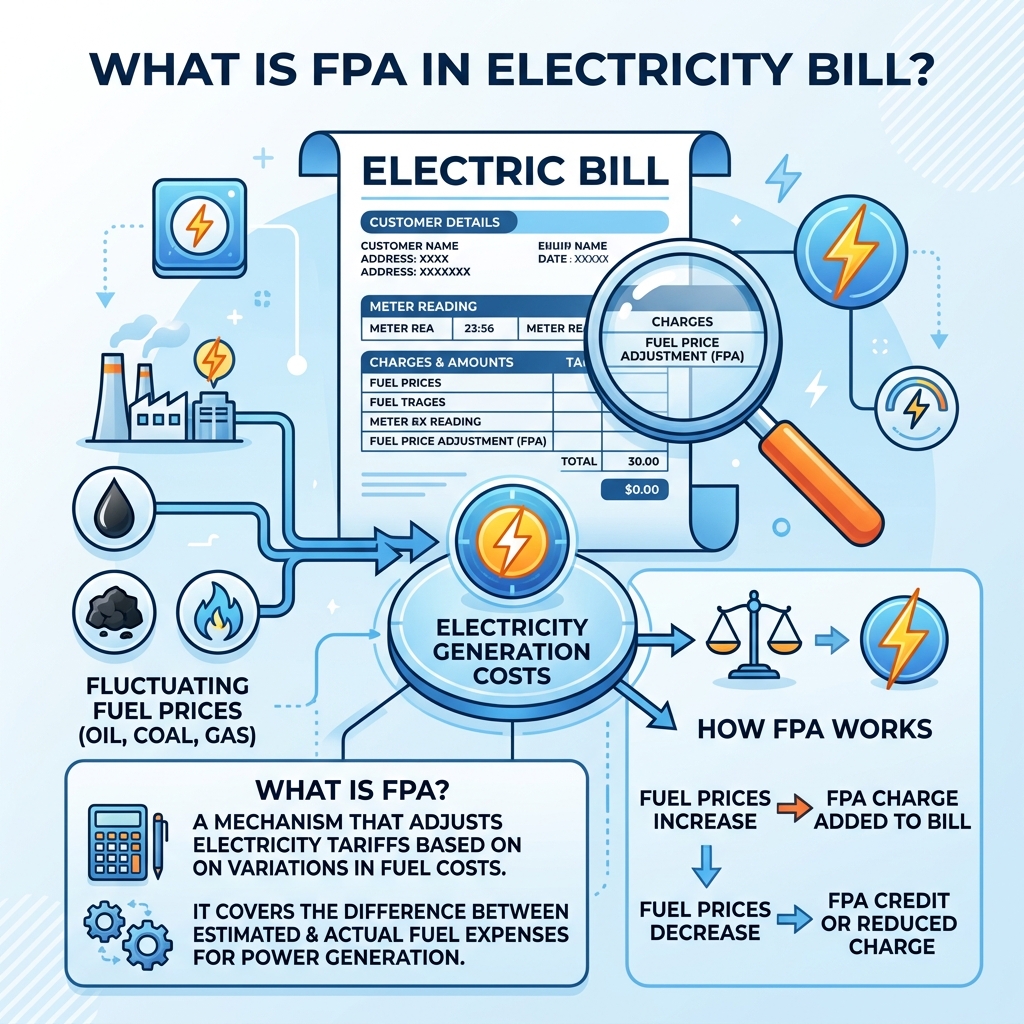
FPA on your electricity bill stands for Fuel Price Adjustment.
FPA — Fuel Price Adjustment, also called FCA (Fuel Charges Adjustment) on some bills and in some NEPRA notifications — is a separate line item on your electricity bill that adjusts for the real cost of the fuel used to generate that month's power. FPA and FCA are the same charge; different DISCOs and news outlets simply use different names for it.
In simple words:
FPA is a monthly extra charge (or sometimes a refund) that adjusts your bill according to the actual cost of fuel used to generate electricity.
It’s one of the main reasons your bill keeps changing even when your units (kWh) are almost the same.
Here's the simplest way to understand why it exists: at the start of each fiscal year, NEPRA sets a reference fuel cost — essentially an estimate of what generating electricity should cost per unit. But actual fuel costs — for furnace oil, natural gas, diesel, imported RLNG, and coal — shift every month with global prices. When the real cost comes in higher than the reference, that difference gets passed on to consumers as a positive FPA charge. When it comes in lower, consumers get a negative FPA — a small credit reducing that month's bill.
Bill Check Online explains this the way NEPRA's own determinations describe it: FPA isn't a DISCO deciding to charge you more. It's a regulated pass-through mechanism, decided by NEPRA, based on data submitted by CPPA-G.
Why Does FPA Exist?
Electricity in Pakistan is generated using different fuels:
- Oil / Diesel
- Natural Gas / RLNG
- Coal
- Hydro (water)
- Nuclear, Solar, Wind, etc.
When the government/NEPRA sets the base tariff (the per‑unit rate in your bill), it assumes a reference fuel cost. But in reality:
- International oil and gas prices go up and down.
- The mix of power plants changes (more thermal in some months, more hydro in others).
- Sometimes power plants use more expensive fuel than planned.
So NEPRA uses FPA to adjust the difference between:
- Assumed (reference) fuel cost in the base tariff, and
- Actual fuel cost incurred in generation.
This ensures that power generation companies recover their real fuel costs, and consumers pay according to actual conditions.
How FPA Appears on Your Bill
On your electricity bill (paper or duplicate), look for a line like:
- FPA
- F.P.A.
- Fuel Price Adjustment
- FC Adjustment / Fuel Cost Adjustment
It usually shows:
- FPA rate per unit (e.g., Rs 6.25 per kWh)
- Your units consumed (e.g., 250 units)
- Total FPA amount = FPA rate × units (e.g., 6.25 × 250 = Rs 1,562.50)
This amount is added to your energy charges before taxes.
Who Sets FPA, and How
There's an actual regulatory process behind every FPA figure that lands on your bill — it isn't set unilaterally by your DISCO:
- CPPA-G calculates the real cost. The Central Power Purchasing Agency (Guarantee) Limited — the state entity that buys electricity on behalf of all the DISCOs — tallies the country's total fuel cost and total units generated for the month, giving an actual per-unit fuel cost.
- CPPA-G files a petition with NEPRA, under Section 31(7) of the NEPRA Act (XL of 1997), comparing that actual cost against the year's reference fuel cost and requesting the difference be passed on.
- NEPRA holds a public hearing. These are open sessions — consumers, industry stakeholders, and trade bodies can attend and raise objections before any decision is finalized.
- NEPRA issues a formal determination. NEPRA doesn't always approve the full amount CPPA-G requests — it reviews the underlying generation data itself and can approve a lower figure. This happens regularly: in one recent month, CPPA-G requested a Rs. 0.82/unit increase, and NEPRA approved only Rs. 0.3364/unit after reviewing the petition.
How FPA Is Calculated (Simple Formula)
At a high level:
Where:
- FPA Rate is decided monthly by NEPRA for each DISCO (LESCO, FESCO, MEPCO, GEPCO, PESCO, HESCO, QESCO, TESCO, HAZECO, SEPCO, IESCO — or K-Electric, etc.).
- It is based on the actual fuel cost of generation for a specific month vs the reference fuel cost already included in tariffs.
Important timing point:
- The FPA you see on this month’s bill is usually for electricity generated two months earlier.
- Example: FPA on your August 2026 bill is often based on June 2026 generation costs.
- NEPRA approves the FPA rate roughly 15–25 days after the month ends, then DISCOs apply it to the next month’s bills.
Positive FPA vs Negative FPA
Positive FPA (Most Common)
- Actual fuel cost > reference fuel cost
- FPA rate is positive (e.g., +Rs 5.80 per unit).
- This increases your bill.
This happens when:
- International oil and gas prices rise.
- More thermal (oil/gas) generation is used.
- Hydro generation is low (less cheap hydro, more expensive thermal).
Negative FPA (Refund / Reduction)
- Actual fuel cost < reference fuel cost
- FPA rate is negative (e.g., –Rs 1.20 per unit).
- This reduces your bill (you effectively get a small refund per unit).
This can happen when:
- Fuel prices fall.
- There is high hydro generation (more cheap water-based power).
- Generation mix shifts to cheaper sources.
In practice, in Pakistan, FPA is positive in most months, so it usually adds to your bill.
How FPA Affects Different Consumers
FPA is a per‑unit charge, so:
- The more units you consume, the higher your total FPA.
- A 700‑unit summer bill will have a much larger FPA amount than a 150‑unit winter bill, even at the same FPA rate.
Example (assuming FPA rate = Rs 6.00 per unit):
- 150 units: FPA = 150 × 6 = Rs 900
- 400 units: FPA = 400 × 6 = Rs 2,400
- 700 units: FPA = 700 × 6 = Rs 4,200
So FPA hits high‑usage households, businesses, and industries much harder.
Where FPA Fits in Your Total Bill
A simplified view of a typical residential bill:
- Energy Charges (based on slab rates: protected/unprotected)
- FPA (Fuel Price Adjustment) = FPA rate × units
- Fixed Charges (based on sanctioned load / slab)
- Taxes & Surcharges (GST, TV License Fee, Electricity Duty, QTR, etc.)
FPA is applied before taxes, so when FPA goes up, your taxable amount also goes up, making the overall impact even larger.
Why FPA Changes Every Month
FPA changes because:
- Global fuel prices (oil, gas, LNG) change.
- Generation mix changes (more hydro in monsoon vs thermal in dry months).
- Currency exchange rate changes (since fuel is often imported in dollars).
- NEPRA’s monthly calculations and approvals.
Can Consumers Avoid FPA?
You cannot remove FPA from your bill – it’s a regulatory charge applied to all consumers across DISCOs. But you can reduce its impact:
- Reduce your units: Since FPA is per‑unit, using fewer kWh directly lowers your total FPA.
- Use energy‑efficient appliances (inverter ACs, LED lights, efficient fans, etc.).
- Shift some load to solar (net metering or hybrid systems) to cut grid consumption.
- Avoid crossing high slabs – this doesn’t remove FPA, but keeps your overall bill lower.
Quick Example: How FPA Changes Your Bill
Assume: You consumed 300 units in a month. Base energy charges = Rs 6,000. FPA rate = Rs 6.50 per unit.
- FPA amount = 300 × 6.50 = Rs 1,950
- New subtotal (energy + FPA) ≈ 6,000 + 1,950 = Rs 7,950
If next month FPA drops to Rs 3.00 per unit and you still use 300 units:
- FPA = 300 × 3 = Rs 900
- Subtotal ≈ 6,000 + 900 = Rs 6,900
Real 2026 Examples
To make this concrete, here's how FPA moved over several recent months (generation month → the bill it actually appeared on):
| Generation Month | Approved FPA/FCA | Appeared On Bills | Notes |
|---|---|---|---|
| January 2026 | ~Rs. 1.63/unit | March 2026 | One of the year's larger increases; combined with a Rs. 0.35/unit Quarterly Tariff Adjustment (QTA) in the same billing cycle for a total Rs. 1.98/unit hit |
| February 2026 | ~Rs. 1.42/unit | April 2026 | — |
| May 2026 | Rs. 0.3364/unit (approved, down from Rs. 0.8173/unit requested) | July 2026 | NEPRA approved less than CPPA-G's request after reviewing the petition |
| June 2026 | Rs. 1.20/unit (requested, pending hearing) | Expected ~August 2026 | Would add an estimated Rs. 18 billion nationally if approved as requested |
What this means practically: if fuel prices spike globally in a given month, you won't feel it on your very next bill — you'll feel it roughly two billing cycles later.
Key Points to Remember
- FPA = Fuel Price Adjustment.
- It reflects the difference between actual fuel cost and reference fuel cost for electricity generation.
- Decided monthly by NEPRA and applied by all DISCOs (LESCO, IESCO, K‑Electric, PESCO, etc.).
- Can be positive (extra charge) or negative (small refund), but in Pakistan it’s usually positive.
- Applied per unit, so higher consumption = much higher FPA.
- Appears as a separate line on your bill and is included before taxes.
- You can’t remove it, but you can reduce its impact by using fewer units and improving efficiency.
Related Reading
- Protected vs Unprotected Consumers — why your tariff category affects both your base rate and, in some cases, how much of the FPA charge applies to you.
- Slab Benefit & Slab Jump Explained — how the residential slab structure calculates your energy charge before FPA is even added.
- TV Fee, GST, Electricity Duty & TRS Explained — a full breakdown of every other charge on your bill besides FPA.